

If you've lived through even one Alberta winter, you know it doesn't play by the rules. One week it's a -30°C deep freeze, the next it's a sudden warm spell melting everything in sight — followed by a hard refreeze that turns your driveway into a skating rink. Add in gravel roads, blowing snow, crosswinds on the highway, and the usual chaos of city driving, and it's clear: not every vehicle is built for this.
That's where SUVs earn their keep. Higher ground clearance means you're not scraping through unplowed side streets, and with more cargo and passenger room, they handle everything from grocery runs to gear-loaded weekend getaways. And since nobody actually knows how much snow we're getting this year, having a vehicle that's ready for whatever shows up just makes life easier.
What Actually Matters When It's -30°C Out
Before we get into specific models, here's your winter feature cheat sheet — the stuff that separates a good winter vehicle from a great one:
- Heated everything — steering wheel, front seats, rear seats. Once you've felt a heated steering wheel on a -25°C morning, there's no going back.
- Remote start — warm cabin, clear windshield, zero shivering. Future-you will thank present-you.
- All-weather mats — because slush, salt, and gravel don't stand a chance.
- AWD or 4WD — non-negotiable for confident traction on ice and packed snow.
- A full-size spare — a donut tire on a rural highway in January is nobody's idea of a good time.
- A working block heater — the quiet hero of frigid mornings. Plug in overnight, thank it later.
Compact SUV Options
For drivers who want winter capability without the bulk, these compact SUVs are proven performers on Alberta roads:
- Toyota RAV4
- Honda CR-V
- Subaru Forester
- Mazda CX-5
Three-Row SUV Options
Need room for the whole family, plus gear, plus whatever the dog drags in? These three-row SUVs bring the space:
- Toyota Highlander
- Toyota 4Runner
- Hyundai Palisade
- Honda Pilot
- Ford Explorer
Since these come up at all kinds of years and trims, here's the general idea of what each one brings to the table — the strengths that hold true across most model years, not just one specific trim.
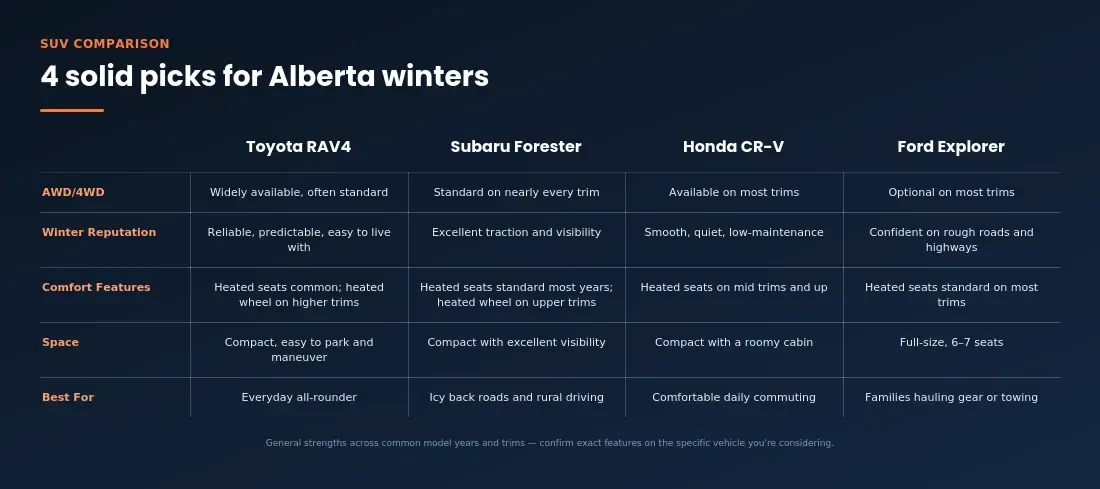
Rule of thumb: if you're mostly city driving with the occasional snowy highway trip, a compact like the RAV4 or Forester covers you. If you're hauling kids, gear, or a trailer through the mountains, the Explorer earns its keep. When you're looking at a used model, the general strengths above hold. Just confirm which specific features (heated wheel, remote start, AWD vs. FWD) came on the exact year and trim you're looking at. There's no single "best" SUV for an Alberta winter; it comes down to what you actually need out of your daily driver, whether that's fuel-sipping efficiency, three-row family space, or something that can tow a trailer one weekend and shrug off a snowstorm commute the next. Every SUV on this list can handle an Alberta winter. The right one just depends on your commute, your cargo, and your budget. Stop in and we'll help you narrow it down.


